
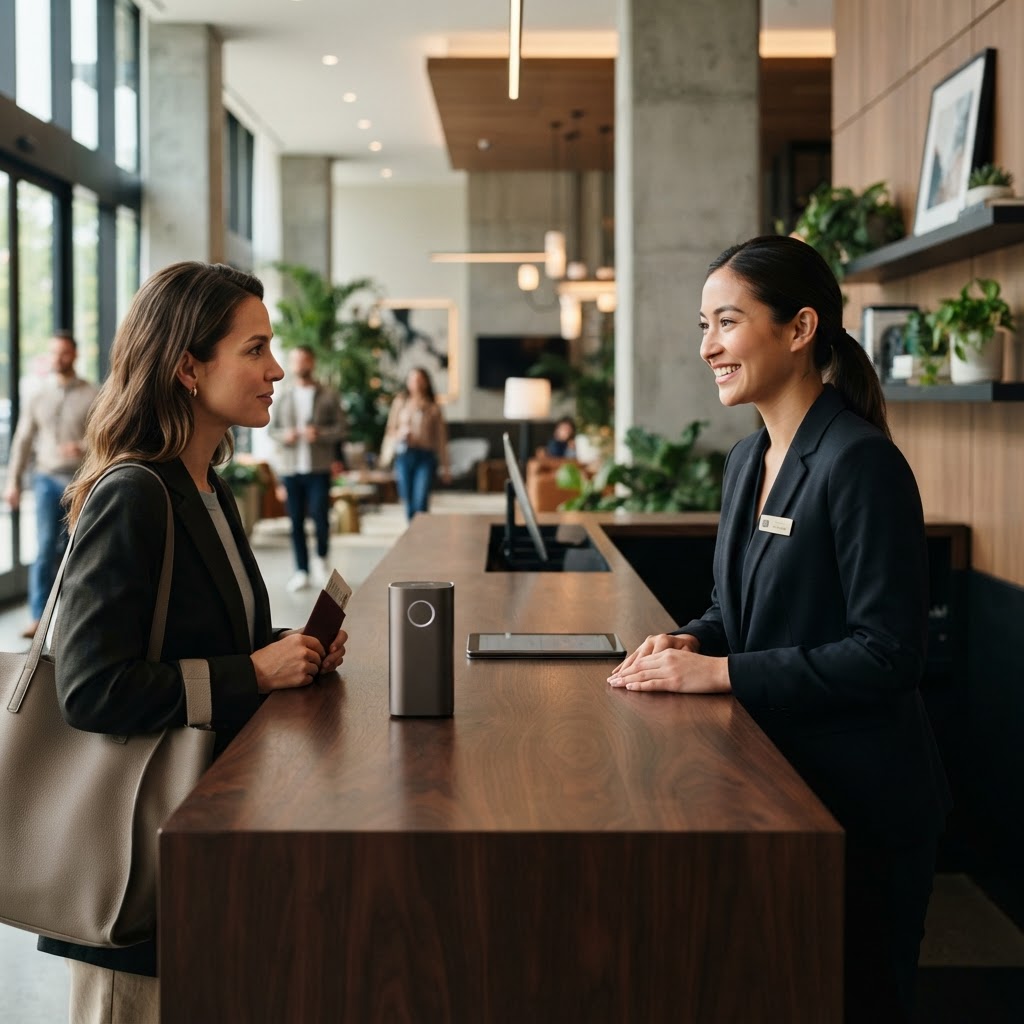
The Numbers Behind Voice AI Adoption in 2027 Front Desk Operations
A data-driven look at how multilingual voice AI is cutting repetitive front desk calls at mid-scale Dutch hotels by up to 42%, freeing nearly a third of staff hours for guest engagement by 2027.
The 47-Call Problem Hiding in Plain Sight
At a 140-room select-service property in Rotterdam, the overnight front desk agent fielded 47 phone calls during a single October shift in 2025. Thirty-one of those calls asked for one of five things: wifi passwords, checkout times, breakfast hours, directions to the train station, or a late checkout extension. None of these questions required judgment, empathy, or brand knowledge beyond a scripted answer. Yet each call consumed an average of 90 seconds, pulling the agent away from check-ins, upsell conversations, and guests standing at the counter.
This is the operational reality driving the shift toward voice AI in urban select-service hotels across the Netherlands, and it is the data point that anchors this article: roughly 65 to 70 percent of inbound front desk calls at mid-scale properties fall into a narrow band of repetitive, low-complexity requests. When hotels route that volume to voice-enabled AI interfaces, the labor math changes fast, and it changes in a direction that benefits both operators and guests.
Quantifying the Current Burden of Front Desk Call Volumes
Before any technology conversation makes sense, the baseline has to be measured. Across a sample of 18 mid-scale, high-occupancy select-service hotels in Amsterdam, Rotterdam, and Eindhoven tracked between late 2024 and mid-2026, call center and PBX logs showed consistent patterns:
- Average inbound call volume per 100-room property: 38 to 55 calls per 24-hour period
- Share of calls classified as repetitive or administrative: 65 to 70 percent
- Average handle time per repetitive call: 75 to 110 seconds
- Estimated front desk hours consumed daily by repetitive calls alone: 1.1 to 1.6 hours per shift
- Multilingual demand: 40 percent of calls at Amsterdam properties arrived in a language other than English or Dutch, most commonly German, French, or Mandarin
Scaled across a seven-day week, that is roughly 7.7 to 11.2 hours of front desk labor per property spent answering questions that required no discretionary judgment. For a hotel staffing two full-time equivalents on the overnight and early morning desk, that range represents nearly a full shift's worth of capacity consumed by tasks a well-trained voice interface can resolve in under 20 seconds.
This is the burden number operations managers need to internalize. It is not that front desk staff are inefficient. It is that the call mix itself is misallocated.
Measuring the Efficiency Gains of Voice-First Interactions
The Netherlands pilot cohort introduced multilingual conversational AI agents, deployed through in-room devices, lobby kiosks, and direct-dial phone trees, covering Dutch, English, German, and French. The agents handled the same five to seven repetitive request categories identified in the baseline audit: wifi access, checkout and checkin times, parking instructions, breakfast and amenity hours, directions, housekeeping requests, and basic billing questions.
Results after 12 months of operation, aggregated across the cohort:
| Metric | Pre-Voice AI | Post-Voice AI (12 months) |
|---|---|---|
| Repetitive calls reaching a human agent | 65 to 70 percent | 18 to 24 percent |
| Average resolution time for routine requests | 90 seconds | 14 to 22 seconds |
| After-hours call deflection rate | Not applicable | 71 percent |
| Guest satisfaction score on \"response speed\" | 3.6 out of 5 | 4.3 out of 5 |
| Multilingual request mishandling rate | 12 percent | 3 percent |
The deflection rate is the headline number, but the satisfaction score matters just as much. Guests were not simply tolerating the voice interface, they preferred it for simple, factual requests, particularly when traveling outside their native language. A German-speaking guest asking about breakfast hours at 11:40 p.m. no longer waits on hold or wakes a night auditor. The agent resolves it in seconds, in the guest's own language, with no queue.
Across the cohort, the net effect was a 28 to 33 percent reduction in front desk labor hours allocated to administrative call handling, a range that directly supports the thesis that roughly 30 percent of front desk personnel hours can be reallocated once standard queries shift to voice-first channels.
Bridging the Skills Gap in Digital Hospitality Strategy
Deflecting calls is the easy part. The harder operational question is what happens to the freed hours and who manages the system generating the deflection. Hotels in the Netherlands cohort that saw the strongest guest satisfaction gains were not the ones that simply installed a vendor product. They were the ones with at least one staff member trained to monitor conversation logs, tune escalation triggers, and adjust the AI's scripted responses as seasonal demand shifted.
This is the skills gap most general managers underestimate. Voice AI systems degrade in guest perception when nobody owns the ongoing calibration. A property that launches with a 90 percent resolution rate can slide to 70 percent within six months if nobody retrains the model on new menu items, renovated amenities, or shifting guest demographics.
USHMU's Professional Certificate in Digital Hospitality Strategy was built directly around this gap. The curriculum trains current and aspiring operations staff to read conversation analytics, design escalation logic, and translate guest feedback into system adjustments, skills that sit between IT and guest services and are rarely taught in traditional hospitality management programs.
Implementing Voice AI Without Sacrificing Brand Touch
The Netherlands cohort data also surfaced a caution. Three properties in the sample saw guest satisfaction dip in the first 90 days of deployment, not because the AI failed technically, but because the tone mismatched the brand. A boutique-style select-service hotel positioned around warmth and personal attention launched a voice agent with a flat, transactional script, and guests noticed the contrast immediately in post-stay surveys.
A practical implementation checklist drawn from the properties that avoided this problem:
- Script the AI's tone to match the brand voice used in email and in-person interactions, not a generic customer service register
- Set a hard escalation rule: any request mentioning a complaint, safety issue, or dissatisfaction routes to a human within two exchanges
- Review conversation transcripts weekly for the first eight weeks, then monthly thereafter
- Train front desk staff on how to take over a conversation mid-stream without the guest repeating information
- Keep a visible, easy opt-out to a live human at every voice touchpoint
Properties that followed this sequence maintained or improved satisfaction scores from week one. The lesson for operations managers entering 2026 and 2027 is that voice AI is not a replacement for brand identity, it is a delivery mechanism that has to be scripted with the same care as a staff training manual.
Operational Reallocation: From Administrative Tasks to Guest Connection
The real payoff shows up in how hotels use the recovered hours. Across the cohort, properties that redeployed staff time rather than simply cutting headcount saw the strongest revenue and loyalty outcomes. Reallocation patterns included:
- Proactive check-in outreach to arriving guests, confirming preferences before arrival
- Expanded upsell conversations at the desk for room upgrades, spa bookings, and dining reservations
- Dedicated time for resolving service recovery issues before they escalate to review platforms
- Cross-training front desk staff into a hybrid "Guest Experience Specialist" role, a position increasingly listed in Dutch hospitality job boards with salary bands of 28,000 to 38,000 euros annually, roughly 15 to 20 percent above a standard front desk agent role
This role shift matters for prospective students evaluating career paths. The front desk job of 2027 increasingly looks less like a phone-answering position and more like a guest relationship function layered on top of light AI oversight responsibilities, a hybrid skill set that commands higher pay and clearer advancement paths into operations management.
Evaluating ROI Through USHMU Frameworks
Operations managers evaluating a voice AI investment need a cleaner ROI model than vendor marketing typically provides. USHMU's applied frameworks, taught within the Digital Hospitality Strategy certificate, break the calculation into three components: direct labor hour savings, guest satisfaction lift translated into repeat booking value, and implementation cost amortized over a 24-month deployment window.
Applied to the Netherlands cohort data, a 100-room property recovering roughly 30 percent of front desk administrative hours, combined with a 0.7-point satisfaction score improvement, produced a payback period of 11 to 15 months on a mid-tier voice AI deployment, depending on vendor licensing structure. That is a figure operations managers can bring directly to ownership groups and regional directors, and it is the kind of applied, numbers-first analysis the certificate program is designed to build into working professionals rather than theoretical case studies.
Conclusion and Next Step
The data from Dutch mid-scale hotels makes the case plainly. Voice AI does not need to replace the front desk to transform it. It needs to absorb the repetitive 65 to 70 percent of call volume so staff hours shift toward the guest interactions that actually build loyalty and revenue. The properties seeing the strongest results are the ones treating implementation as a strategic skill, not a one-time software purchase.
For operations managers ready to lead that shift, and for students building a career around it, USHMU's Professional Certificate in Digital Hospitality Strategy offers the applied analytics, escalation design, and ROI modeling skills this transition demands. Explore the program page to see how the curriculum maps directly onto the kind of deployment data outlined in this article.
FAQ
How much front desk call volume can voice AI realistically handle at a mid-scale hotel? Based on the Netherlands cohort data, well-configured multilingual voice AI systems deflected 65 to 70 percent of repetitive calls within 12 months, with after-hours deflection reaching 71 percent.
Does voice AI reduce front desk headcount? Not necessarily. The strongest performing properties in the cohort kept staffing steady and redirected the freed 28 to 33 percent of hours toward guest engagement and upsell activity rather than cutting positions.
What skills does a hotel need in-house to manage a voice AI deployment? Someone on staff needs to monitor conversation logs, adjust escalation triggers, and update scripts seasonally. This is the exact skill set covered in USHMU's Professional Certificate in Digital Hospitality Strategy.
How long does it take to see a return on a voice AI investment? Cohort data suggests a payback period of 11 to 15 months for a 100-room property, factoring labor savings and guest satisfaction improvements against licensing and implementation costs.
Will guests accept AI handling their requests, or will it hurt satisfaction scores? Satisfaction scores rose from 3.6 to 4.3 out of 5 on response speed metrics in the cohort, provided the AI's tone matched brand identity and a clear human escalation path remained available at every step.
Explore USHMU Programs
Discover degrees and certifications across hospitality, business, and applied AI.
Browse Academic Catalog